Selective use of AI respects the boundary that protects a writer’s work, audience, and growth

I had just typed half of my prompt into Claude’s chat window when my fingers froze over the keyboard. After weeks of working on the story map that outlined my latest novel, I’d nailed most of the chapter beats that marked the twin evolutions of my protagonist and plot. Now I just needed to plant the seeds in my hero’s childhood that inspired the growth he realized during his journey. But as my fingers flew, my gut gave a flip that made me stop and reread what I’d typed:
Analyze this story map and give me some ideas…
I gave a groan and started pecking again. But this time, I backspaced until I cleared the text from my screen. I’d just broken the cardinal rule I’d set for myself when I first opened the Pandora’s Box we call AI.
The Backstory of My AI Tale
When it comes to writing a story, I’m no fly-by-the-seat-of-your pantser. I plot. A lot. And a career as an illustrator and graphic designer has armed me with an array of digital tools that can be a great way to distract myself when trying to find my way into a tale. Usually, however, my use of color and form to look at the shape of a story bolsters, not blocks, my work. When the three AI’s I regularly use (Claude, ChatGPT, and Perplexity) rolled out image analysis, they granted both visual and verbal tools for getting a fresh perspective on my book. In short, I now had two ways to see it clearer—with a mirror.
What stopped my prompt that morning after I uploaded my latest narrative graphic was the maxim I’ve adopted as my own personal code for using AI. I employ it judiciously to advance my writing through Reflection, Not Conception. That edict sets the rules and roles for how AI and I play together: I am the creator, but I welcome AI as a co-developer of my creations. As creator, I’m responsible for the inspiration, ideation, and writing of my work. It’s up to me to mine my life for the stories I’m excited to explore and come up with the themes, characters, and plots that shape them. I’m also the one responsible for both writing and revising the language that shares them with the world. As co-developer, AI is charged with assisting me in the research, analysis, and criticism that yields my novels’ raw material, reveals their mechanics, and evaluates the merits and faults of every story I tell.
A Rule Ruled by Respect
My self-imposed rule for AI use is supported by three principles that reflect the integrity I seek to maintain in my work. This triad is founded in a legal, ethical, and professional framework based on respect for the following three tenets.
#1: Respect the Rights of the Creator
All art is derivative, of course. Pick your favorite artistic icon and you can trace their genius from its roots in the work of the legions of masters who came before them. But the border between copying and creating can be a tricky one to navigate. When I was working as a brand strategist tasked with coining a new name for a company, my constant dives into the US Patent and Trademark Office’s database were guided by the legal principle of “fair use.” Its guiding proposition is the notion of “transformative” work as the standard for differentiating between original and copied works. That mandate to “add something new, with a further purpose or different character,” and not simply offer a “substitute for the original use of the work,” was my guide for the monikers I invented for my clients. Vetting the legality of those new names was a task for their attorneys. But the principle of fair use let me clear my creation with the arbiter that mattered most to me: my conscience. That’s the same guide I use when creating a book.
#2: Respect the Expectations of the Reader
When I pick up a novel, I’m looking for more than just escape. That doesn’t negate my passion for a tale that casts a spell so deep it can have me flipping pages while the walls around me are coming down. But I’m also looking for the author to reach across space and time to touch my life with something that’s touched theirs. That ability to uncover and convey life’s meaning is why I write, and what I’m looking for in the books that stay with me long after I reach “the end.” So, while I know the large language models AI was weaned on have enough stories stored up to slice and dice into countless new ones, that sort of literary hash is not my cup of tea. And if I’m not going to down it, I’m certainly not going to serve it up to my readers. Because once you remove the human spark from a story, what you’re left with is just something to pass time with— not something that makes the time you passed worthwhile.
#3 Respect the Growth of the Writer
Every novelist wrestles with their story. Like many, I’m always trying to do two things while penning mine: 1) write my story and, 2) learn how to write it. After reading a score of books on the craft, hosting a writer’s group for eleven years, attending classes and conferences, and writing six novels, AI is just the latest tool I’ve found to support that goal. But the struggle to shape a narrative doesn’t just work to build a book. It builds the writer too. And even if I wanted to outsource that burden to a bot, how could it ever shoulder it the way we writers do? I’ve written stories that only later revealed to me the parts of myself that made it onto the page. Whether a buried childhood insult, the touch of a loved one’s hand, or simply the feel of the summer sun on my face, I’ve found every painful, joyful, and transcendent moment that’s enriched my life has provided grist for my writer’s mill more valuable than any amount of data our silicon sidekicks can digest. So I’ll continue to task my AI associates only to reflect on the concepts I conjure from the beautiful mess I call my life.
A Practical Peek at My Rule
Want a look at how my mandate for AI use is applied to my work? Here’s a view of how I reminded myself of it when outlining “Last Catch,” the novel I’m wrestling with now.
1: After spotting flaws in the early chapters outlined in the red box below, I made a creative flaw by asking Claude for ideas to improve them, but stopped myself before sending that prompt:
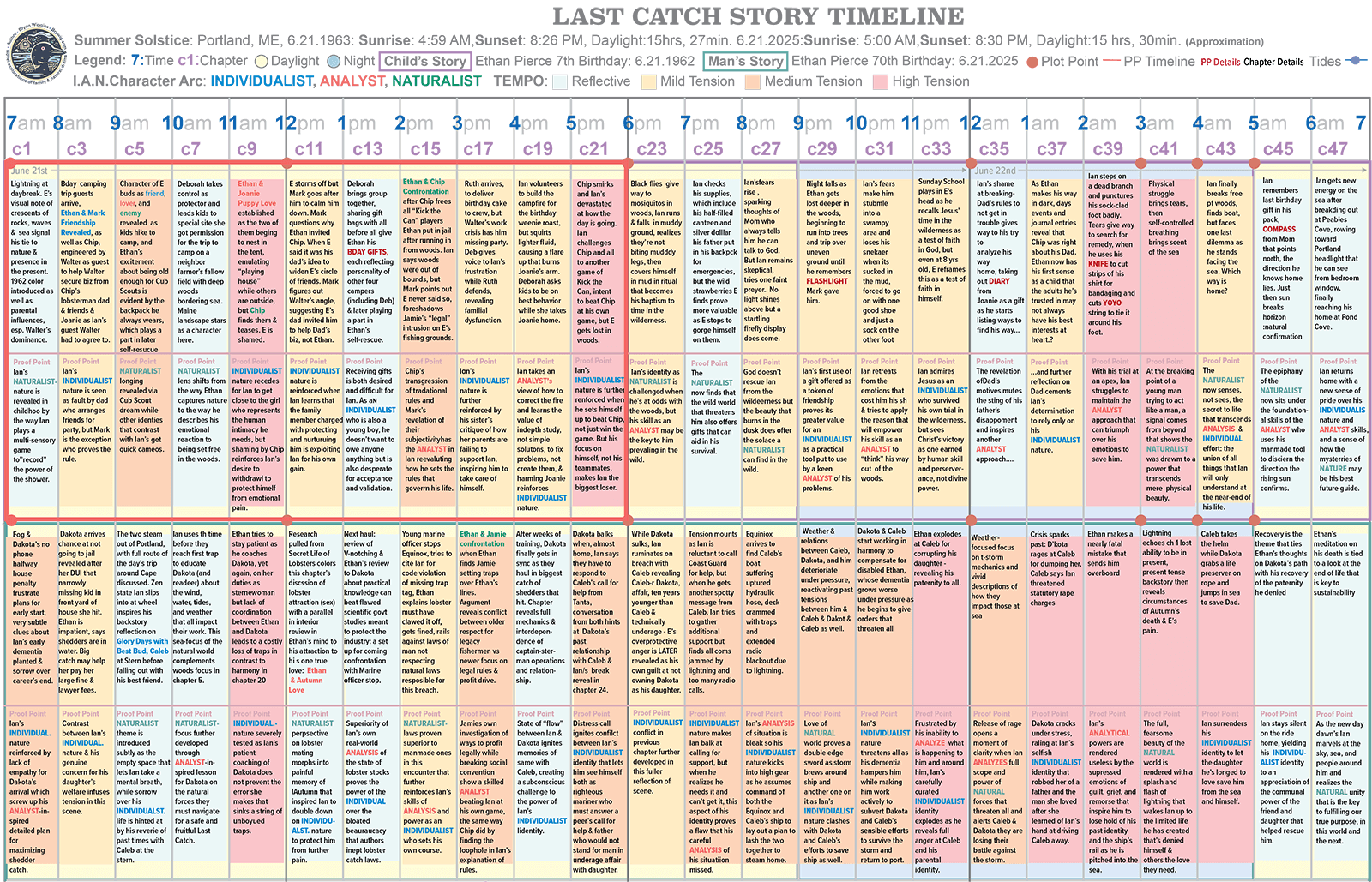
2: I then pivoted to ping Claude for his critique of my analysis of my story problem:

3: Solving the issue myself nurtured my novelistic skills while revealing key areas of growth for my protagonist that I could then vet with feedback from Claude:

4: With my own rules for AI use clearly defined and illustrated by the example above, I archived this post as a foundational document in ChatGPT—the latest AI I’m exploring for research and review of the human-conceived and crafted stories I’m committed to create myself.
 BRYAN WIGGINS
Bryan,
THis is just incredible! I love how you recognize the value of AI—but set boundaries in order to be true to your artistic writing self. You could /should be a mentor to writers.
I’m cc’ing Ken since he will so value what you are doing!
Cyndi
P.S. Can’t wait to read The Last Catch!
>
LikeLike
Thanks so much for checking out the post, Cyndi! I’m ten chapters into Last Catch and will certainly be looking forward to your beta read!
Best,
Bry
LikeLike
Heh heh. Looks like you’ve finally put your thoughts to blog on this subject. Good show, Bry.
What a day it was today. Bryan, please let me know when we should book our next walk.
Cheers,
Ken
From: Cyndi Alden cyndi@aldenmail.com
Sent: Tuesday, October 21, 2025 5:43:11 PM
To: BRYAN WIGGINS comment+pg5dzhazua8d93h5ssxn4tq@comment.wordpress.com
Cc: Ken Alden ken@aldenmail.com
Subject: Re: Reflection, Not Conception
Bryan,
THis is just incredible! I love how you recognize the value of AI—but set boundaries in order to be true to your artistic writing self. You could /should be a mentor to writers.
I’m cc’ing Ken since he will so value what you are doing!
Cyndi
P.S. Can’t wait to read The Last Catch!
LikeLike
Thanks, Ken. Conversations with you have been critical in helping me shape my AI use. I’ve switched from Claude to Chat GPT because of the latter’s contextual “top-level” awareness of subjects discussed in all threads. With Claude, I have to continually remind it of things like the target genre and audience I’m working for every time I ping it for accurate analysis of my prose. I’ll book a walk to talk with you more about all soon!
LikeLike
Thanks, Ken. Conversations with you have been critical in helping me shape my AI use. I’ve switched from Claude to Chat GPT because of the latter’s contextual “top-level” awareness of subjects discussed in all threads. With Claude, I have to continually remind it of things like the target genre and audience I’m working for every time I ping it for accurate analysis of my prose. I’ll book a walk to talk with you more about all soon!
LikeLike
Very interesting.
Using AI as a/your tool vs. being subject to it.
Let it help you be the creator you are.
Wendy
Wendy A. Laidlaw
Personal email: WendyLaidlaw@me.com
Cell Phone: 207-228-3736
LikeLike